
TLDR: The manager-versus-leader binary is an outdated corporate myth, constructed for Fortune 500 boardrooms and neurotypical brains. It was never designed to describe what an early-stage COO, Integrator, or Operations Leader actually executes every day. For ADHD-wired operators, this false hierarchy devalues execution, triggers unnecessary guilt, and ignores how high-growth businesses actually scale. This article dismantles the academic myth, reframes the second-in-command seat, and proves why execution is genuine leadership.
Nobody grows up wanting to be a used car salesman. The stereotype is vivid, cartoonish, and universal: the cheap polyester suit, slicked-back hair, crushing handshake, and a smile working far too hard.
When you actually need to buy a reliable vehicle, that role becomes essential. The sales professional walks one of the most demanding lines in commerce: your strict budget versus the dealership’s profit margin, your family’s safety needs versus available inventory, relationship versus immediate bottom-line result.
That unrelenting tension, holding human care and concrete outcomes in balance simultaneously, is not a lesser administrative task. It is not the absence of vision. It is the exact job description of an Anchored Operator.
Yet for thirty years, mainstream business media has told operational leaders that if they care about tasks, deadlines, and execution, they are failing as leaders.
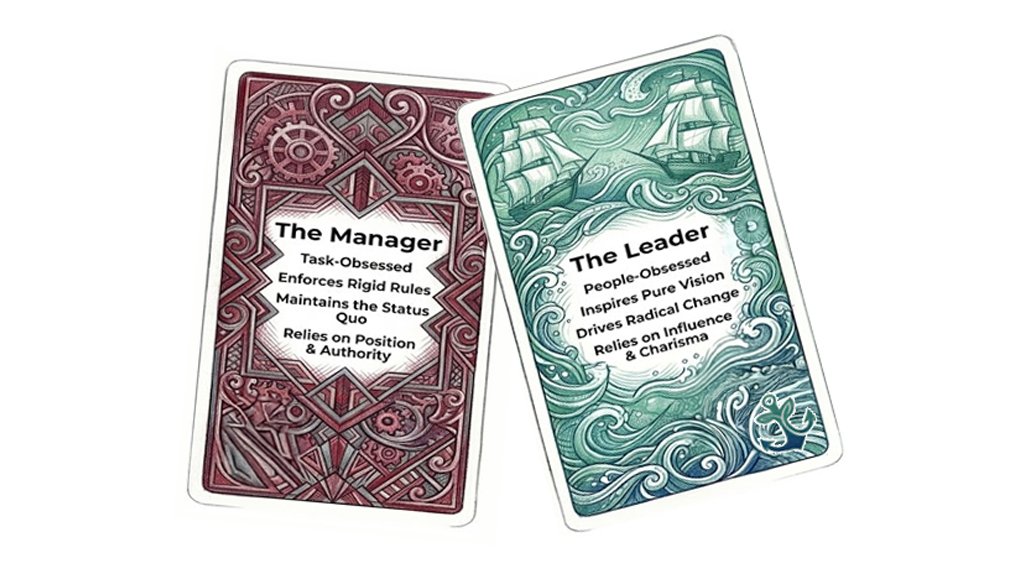
The Desk Cards: How Corporate Culture Created the “Bad Manager” Myth
A promotional campaign regularly appears in social feeds, advertising conversation cards designed to help professionals “communicate like a leader.”
The layout is stark. The “Manager” response is stamped in bright red. The “Leader” response glows in encouraging green.
When addressing missed performance, the card presents this contrast:
- The Manager (Red Column): “You really dropped the ball on this task.”
- The Leader (Green Column): “How can I help you become the best version of your future self?”
While there are far more constructive ways to address a missed deadline than a blunt accusation, the underlying message is toxic: managers are cold, narrow-minded taskmasters, indifferent to human potential, whereas leaders are enlightened, empathetic visionaries, floating above operational mechanics.
The Flawed Corporate Narrative
This narrative reduces management to a caricature: Bill Lumbergh from Office Space, standing in a suspendered shirt with a coffee mug, obsessing over TPS reports while remaining disconnected from the work and the humans doing it.
Bill Lumbergh did not fail because he valued tasks. He failed because he cared about neither the tasks nor the people. Building an operational philosophy on a Hollywood caricature is not an executive framework; it is an internet meme.
Consider a real-world titan of business culture.
Steve Jobs is widely revered as the quintessential visionary leader. He reimagined personal computing, animated cinema, digital music, and mobile telecommunications. If those conversation cards sat in an Apple boardroom, nobody would dare place Jobs in the red column.
Yet Walter Isaacson’s biography documents the gritty reality: Jobs was notoriously demanding about shipping dates, micromanaged typography down to the pixel, and scrutinized engineering budgets with relentless intensity. When a timeline slipped or a casing failed to meet his standard of “Done,” his response was never a vague inquiry into someone’s future self.
While Jobs’s abrasive interpersonal approach often crossed into counterproductive cruelty, something Anchored Operators actively reject, the core lesson remains undeniable: the most celebrated visionary of our era operated with unyielding discipline around execution, timelines, and tangible results.
Innovation did not happen despite operational discipline. It happened because of it.
Vision without execution is just an expensive mood board. The tasks were always the point.
Where the Manager vs. Leader Myth Came From (And Why It Misses Your Seat)
The artificial wall between management and leadership was not born on social media; it emerged from mid-century corporate theory.
It began with Peter Drucker in 1967, who drew an operational distinction between efficiency and effectiveness: “Efficiency is doing things right; effectiveness is doing the right things.” Drucker was describing complementary cognitive modes required to steer an organization. He was not establishing a moral hierarchy, nor was he arguing that efficiency was inferior to strategic direction.
That nuance vanished when Warren Bennis and Burt Nanus popularized their famous aphorism in 1985: “Managers are people who do things right, and leaders are people who do the right thing.” It was crisp, memorable, and tailor-made for keynote presentations. It was also stripped of the operational reality that made Drucker’s insight practical.
John P. Kotter expanded the division in his landmark 1990 Harvard Business Review article, “What Leaders Really Do.” Kotter framed management as a stabilizing force (planning, budgeting, organizing) and leadership as a transformative force (aligning people, inspiring change). While he argued that both were necessary, corporate culture quickly assigned all prestige to the “transformative” column, treating the stabilizing function as administrative overhead.
Search “managers vs. leaders” today, and standard business resources will present tables reinforcing this bias:
- Leaders draw from charisma; managers draw from authority.
- Leaders drive innovation; managers maintain stability.
- Leaders motivate and empower; managers direct and control.
Reading these comparisons, an operations professional could easily conclude that the entire discipline of operational management is an embarrassing lower-tier function.
Peter Drucker actively resisted this hierarchy. To Drucker, management was the noble, practical mechanism through which human values and strategic vision were translated into tangible societal impact.
More importantly, none of these historical models were designed for early-stage companies or the modern Integrator seat, nor did they take ADHD or neurodiversity into consideration.
Kotter and Bennis wrote for Fortune 500 enterprises with stratified hierarchies, where an executive suite cast broad vision and insulated middle managers processed bureaucratic checklists. They were not describing early-stage businesses (sub-$1M to $5M ARR). They never accounted for the startup COO, the Fractional Integrator, or the Director of Operations who must build the vision, architect the systems, lead the team, absorb executive friction, and ensure the product actually ships.
That multidimensional operational role did not exist in mid-century academic literature.
To be fair, the more recent generation of leadership thinkers has moved meaningfully closer to the truth.
Simon Sinek built his reputation on Start With Why (2009), a book almost universally shelved in the “leadership” section and written squarely for people who cast visions and inspire movements. The central argument – that people don’t buy what you do; they buy why you do it – sounds, on its surface, like another entry in the leader-as-visionary canon.
Read it more carefully, though, and the operational implications are unmistakable. A team that understands why the work matters will do far more than any incentive structure could ever demand. They don’t need to be micromanaged toward the deadline. They don’t need to be persuaded to care about the outcome. The why is the operating system underneath the execution.
⚡ ADHD Power-Up: For an ADHDer, understanding “The Why” is not philosophical fluff; it is the neurological ignition switch for task initiation. When an operational process lacks clear context or purpose, executive dysfunction kicks in. When the purpose is clear and just, hyperfocus unlocks, and execution flows naturally.
Sinek followed that argument in Leaders Eat Last (2014), where he made the organizational dependency explicit: we need managers to make organizations operate, and we need leadership to create the conditions in which the best people can do their best work. Not one or the other. Both, simultaneously, held by the same person.
That sounds familiar.
Brené Brown went further. In Dare to Lead: Brave Work. Tough Conversations. Whole Hearts. (2018), she opened with a definition that the conversation card manufacturers appear to have missed entirely: “I define a leader as anyone who takes responsibility for finding the potential in people and processes, and who has the courage to develop that potential.”
People and processes. Not people instead of processes. Not vision over execution. Both. In the same definition. From one of the most widely read leadership researchers of the last two decades.
Brown’s work is rooted in vulnerability research, and her argument is that courage is the foundational leadership skill, not charisma, not authority, not positional power. The courage to have the hard conversation. The courage to hold the standard when it would be easier to look away. The courage to tell someone the truth about their performance when the RSD in both of you is making that conversation feel like a minefield.
That is the Anchored Operator’s daily reality. Brown just gave it a name.
Brown doubles down on this integration in Strong Ground (2025), showing that stability is not the enemy of agility; it is its prerequisite. You cannot ask a team to venture into high-stakes ambiguity without giving them a solid base under their feet. For the operational leader, building clear workflows, running tight rhythms, and holding firm boundaries is not administrative bureaucracy; it is the exact grounding that allows the entire enterprise to stand firm, adapt under pressure, and reach the next horizon.
Consider This Post: When the boundary between vision and execution is undefined, operational leaders end up absorbing pure friction. The Visionary and Integrator: 3 Conversations to Define Your Partnership walks you through the exact conversations required to establish clear decision rights so you can stop second-guessing your authority.
What My Degrees in Leadership Development Actually Taught Me
Here is the irony I live with every day.
I hold a Bachelor’s degree in Social Entrepreneurship and Leadership Development. My Master’s is in Entrepreneurship, Innovation, and Leadership. I did not go to school to learn how to manage tasks. I went to study people, vision, organizational culture, and the mechanics of how change actually happens inside a business.
Then I stepped into the COO seat.
Where I managed tasks. Projects. Timelines. People. Budgets. Vendors. Onboarding. Processes that existed only in someone’s head. Fires that arrived before I had finished my coffee.
Here is what I found: every single thing I learned studying leadership was being applied in those management moments. The frameworks for understanding how people respond to change? Applied in performance conversations. The principles of motivation and organizational culture? Applied when building delegation systems and running one-on-ones. The theory of servant leadership? It showed up most clearly when I was doing the unglamorous work of removing obstacles so my team could execute without friction.
The leadership wasn’t happening; it was the management. It was happening through it.
Anchored For Growth exists to transform overwhelmed operators into Anchored Leaders. Not into better taskmasters. Not into more efficient process machines. Into leaders, specifically, who happen to be doing it through the vehicle of operations, systems, and execution.
The degree taught me leadership. The seat taught me that leadership and management are not two different jobs. For a COO, the job is the same, expressed simultaneously every single day.
The binary was never designed for someone doing both. It was designed by people who assumed they were always done by different people.
Outward Vision vs. Inward Architecture: The Executive Partnership
In visionary-led companies, leadership cannot be understood through a single executive lens. It operates as a dynamic partnership.
The Two Horizons of Leadership
| Outward-Facing Leader (CEO) | Inward-Facing Leader (COO) |
| Market & Capital Focus | Team & Operational Focus |
| Storytelling & Horizon Scanning | Execution Infrastructure & Cadence |
| Expansive “Balloon” Energy | Grounding “Anchor” Stability |
| Generates Divergent Possibilities | Designs Repeatable Systems |
The Visionary CEO is the Outward-Facing Leader. They cast long-range vision, evangelize the mission to investors, secure strategic market relationships, and explore new horizons. This visionary energy is expansive, creative, and comfortable with ambiguity. It is essential for growth.
The COO, Integrator, or Operations Leader is the Inward-Facing Leader. You are the leader your team interacts with, leans on, and experiences every single day.
- You establish company culture through daily execution, not abstract values on a wall.
- You design the communication rhythms, project structures, and clear boundaries that prevent burnout.
- You filter the CEO’s “Idea Tornado” into a stable, 90-day operational roadmap by capturing runaway concepts in an Idea Dock.
- You hold the accountability standards that respect your team enough to tell them the truth.
The Visionary CEO acts like a hot air balloon, seeking altitude and scanning the horizon. Without an Anchor, that balloon drifts erratically in every prevailing wind, eventually crashing from structural instability. The COO is the stabilizing force that keeps the entire enterprise tethered to reality, ensuring every flight results in purposeful progress.
When you are the only one holding the operational anchor while everyone else looks at the horizon, the middle seat can feel like the loneliest place in the company.
Internal architecture is genuine leadership. It is simply focused inward toward operational capacity rather than outward toward the market.
🪞 Real Talk: Letting the internet convince you that inward execution is “lesser work” feeds the exact imposter syndrome that burns out great operators. Without your grounding systems, that visionary balloon drifts until it runs out of fuel. Holding down the operational fort is leadership, plain and simple.
ADHD Management: The Dopamine and Execution Tax of the Operational Seat
For an ADHD-wired operator, the corporate myth that “managers are inferior to leaders” creates immediate psychological friction.
ADHD leaders possess powerful operational superpowers: exceptional pattern recognition, intuitive problem-solving during crises, deep empathy, and an intolerance for broken, inefficient systems.
Navigating operational execution with an ADHD brain requires paying an invisible Execution Tax.
Initiating multi-step administrative workflows, prioritizing competing operational requests, maintaining routine schedules, and organizing complex project handoffs demand heavy engagement of the prefrontal cortex. When mainstream business influencers dismiss execution as “low-level management chores,” they devalue the deep cognitive effort neurodivergent operators pour into their businesses.
Furthermore, task initiation in ADHD brains requires clear purpose. In Simon Sinek’s model, understanding “The Why” is a strategic asset. For an ADHD operator or team member, “The Why” is the neurological ignition switch.
- When a rule, process, or deadline lacks clear reasoning, the ADHD nervous system experiences executive dysfunction and friction.
- When the operational context is crystal clear, just, and anchored to real outcomes, the ADHD brain activates hyperfocus, finding creative shortcuts to execute complex systems rapidly.
Management is not mindless compliance. For the neurodivergent operator, designing streamlined systems is an act of cognitive self-defense and team stewardship.
Consider This Post: You’re Not Failing. You’re Being Measured by the Wrong Standard. If you have spent years feeling exhausted by conventional productivity advice, it isn’t because you lack discipline. Discover how neurotypical performance rubrics trap ADHD leaders in a shame spiral and how to redefine success around your natural wiring.
Execution Is the Evidence of Leadership
In early-stage and high-growth companies, execution is where leadership proves its worth.
Every enterprise exists to deliver a specific outcome: software deploys without bugs, client deliverables land on schedule, invoices are reconciled, and payroll clears.
The Anchored Operator’s objective is not to execute every task personally. The objective is to design the systems, structures, and team alignment so outcomes happen reliably without requiring individual heroism.
From Reactive Fixer to Anchored Designer
| Reactive “Fixer” | Anchored “Designer” |
| Manually puts out fires daily | Architects Minimum Viable Systems (MVS) |
| Serves as the central bottleneck | Empowers clear team ownership |
| Dependent on personal heroism | Relies on predictable, stable rhythms |
| Trapped deep in the operational weeds | Leads calmly from the operational center |
When an operational failure occurs, the traditional manager looks for someone to blame. The Anchored Operator looks at system design:
“What breakdown in our operational architecture allowed this mistake to happen, and how do we simplify the process to protect our team from repeating it?”
That is not administrative paper-pushing. That is architectural leadership.
⚓ Pro Tip: When a deliverable slips, resist the urge to jump into heroic firefighter mode. Pause and ask: “Did this fail because of the person, or did the system leave a blind spot?” Fixing the process creates permanent relief; playing the hero just guarantees you’ll fight the same fire next month.
Holding standards, tracking leading indicators, and holding team members accountable to their commitments are caring leadership behaviors. Clarifying expectations removes ambiguity, reduces team anxiety, and establishes psychological safety.
Consider This Post: The Fixer’s Trap: Are You the Business Bottleneck? High-performing operators often become the single point of failure by stepping in to solve every fire manually. Learn how to break the “hero complex” and transition from indispensable doer to strategic systems designer.
Core Operational Takeaways
- The manager-versus-leader binary is an outdated corporate myth.
- Managing execution is genuine internal leadership.
- ADHD brains need clear “Why” frameworks to unlock task activation.
- Clear operational systems build psychological safety across the entire team.
You are not Bill Lumbergh. You are not a bureaucratic villain.
You are the operational anchor keeping the ship steady in turbulent waters.
What’s Coming Next: Unmasking the Internal Alarm
Knowing the leader vs. manager binary is an intellectual lie is the first step, but it doesn’t automatically stop your chest from tightening when a deadline slips or a performance conversation looms.
In Part 2 of this series (RSD in Leadership: Why ADHD Managers Avoid Hard Conversations), we go beneath the strategy and tackle the internal game:
- Meet the Gargoyle: Why ADHD brains treat routine managerial friction as an existential threat.
- Empathetic Avoidance: The hidden trap where protecting your team’s feelings ends up burning you out in secret.
- The 6-Step Self-Doubt Loop: How to catch the spiral early, separate emotion from operational facts, and reclaim your authority in the middle seat.
That is where we take back control of the room.
Next Steps: Operationalize Your Leadership
Mastering the balance between execution and empathy requires practical communication frameworks.
- 🎁 Download: Grab the Anchored Leader’s Effective Feedback Scripts & Cheat Sheet to access exact word-for-word scripts for navigating performance reviews, holding boundaries, and delivering direct feedback without triggering defensiveness.
- 🚀 Audit Your Operations: Take the COO Stability Compass, a free 10-minute diagnostic tool that identifies which operational quadrant is creating friction in your business.
- ⚓ Work 1-on-1: If you are ready to eliminate role ambiguity, align with your Visionary CEO, and master your seat, Book Your Clarity Call to explore the customized 1-1 coaching opportunities, especially for operations people with ADHD.
Frequently Asked Questions About ADHD Manager vs. Leader Dynamics
Ready to Stop Apologizing for Managing Execution?
Your company doesn’t need another abstract visionary floating at 30,000 feet. They need an Anchored Leader grounded in reality: someone who builds the systems, protects the team from the chaos, and turns big ideas into shipped outcomes.
If you’re tired of the “Fixer’s Trap” and ready to lead your seat with clarity, confidence, and authority, let’s connect. In a complimentary 30-Minute Clarity Call, we’ll look at where your operational architecture is leaking time, how to eliminate friction with your Visionary CEO, and identify the single highest-leverage shift to move you from reactive firefighting into anchored leadership.