
I have heard it more than once in my career.
I’d been running operations for a growing business for several years. Making things work. Solving problems before they become emergencies. Growing revenue, building systems, quietly making the owner a lot of money. When I finally sat down and asked, genuinely asked, how I could keep improving and grow, the answer I got was: “Just keep doing what you’re doing.”
I smiled. I nodded. Then I said, “Thanks, but do you have something specific I could focus on?”
They just repeated themselves.
I walked away feeling completely unseen.
I was a young, hungry operations manager who wanted to learn and excel. Here’s the thought that followed me out of that room, and I’ll be honest about it because I suspect you’ve had a version of it too: “Maybe if I underperformed, I’d at least get some attention. Bad attention is better than no attention, right?”
That’s not a joke. That’s an ADHD brain in a feedback vacuum, doing exactly what ADHD brains do — filling the silence with something, anything, to figure out where it stands.
The third time I asked and got the same answer, I started looking for a new job.
I’m not sharing this to relitigate old frustrations. I’m sharing it because I now coach COOs and Operations Leaders who are on the other side of that conversation, the ones giving the feedback, not just receiving it. What I see regularly is well-meaning leaders who genuinely believe that “keep doing what you’re doing” is a compliment.
It isn’t. It’s a missed opportunity at best, and operational sabotage at worst.
This article is for you, the leader who manages people. Let’s talk about how to do this better.
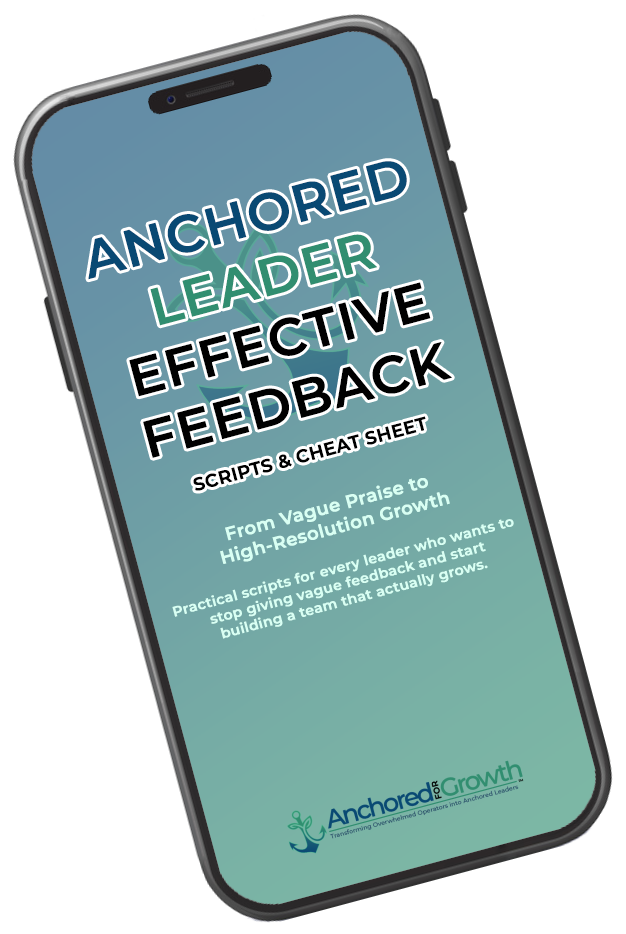
FREE DOWNLOAD: The Anchored Leader’s Effective Feedback Scripts & Cheat Sheet
This 14-page PDF gives you a complete, ready-to-use toolkit built around three conversations every leader needs to have consistently — and the exact language to make them land.
The Appliance Trap: Managing People Like Dishwashers
Think about your dishwasher. You don’t think about it when it’s working. You don’t praise it, ask how it’s doing, or wonder where it wants to grow. You load it, press start, and walk away. You only pay attention when it leaks.
This is how many managers, often unintentionally, treat their best people. As long as the output keeps coming and nothing breaks, there’s no engagement. No Foundation. No Feedback. No Feedforward. Just silence, punctuated by correction whenever something goes wrong.
I call this the Appliance Trap. It hits high performers the hardest because they are the least likely to “leak.” They keep running quietly and efficiently without complaint, right up until the moment they don’t.
When a high performer finally leaves, their manager is almost always surprised. They shouldn’t be. High performers don’t leave because the work got too hard. They leave because they stopped growing, because they started to wonder whether anyone noticed, because they asked for feedback three times and got a shrug. Eventually, they decided their growth mattered more than their loyalty to a ship that wasn’t going anywhere new.
There’s an old adage I’ve found to be more true than not: “People don’t leave jobs. They leave managers.”
Real Talk: If the only time you engage with your top performers is when something goes wrong, you aren’t leading them. You’re monitoring them. Eventually, they’ll find a leader who actually sees them.
Consider This Post: The pattern of managing from silence rather than intention is often a symptom of deeper role confusion between you and your Visionary CEO. The Visionary and Integrator: 3 Conversations to Define Your Partnership is where that conversation starts.
The Manager Who Is Threatened by Your Growth
Sometimes “keep doing what you’re doing” isn’t laziness. Sometimes it’s fear.
A manager who feels threatened by a high performer’s growth has a quiet incentive to keep that person exactly where they are. Because a high performer who grows might outgrow the role, or the manager.
It’s worth sitting with that honestly, because it rarely looks like sabotage from the inside. It looks like being busy. It looks like assuming your best people don’t need much from you because they’re already performing well. It looks like “keep doing what you’re doing,” said with a genuine smile and no awareness of the cost.
I believe the opposite is true. A manager’s job is to help their people grow, which in turn helps the manager grow. When the people around you get better, you get better. When your team develops, your leadership capacity expands. A rising tide lifts all ships, including yours.
If you recognize yourself here, not out of malice, but out of habit, or fear, or simply never having been taught to lead this way, keep reading. What follows is the framework that changes the conversation entirely.
Consider This Post: If your team’s growth is being limited by role confusion rather than capability, The Fixer’s Trap: Are You the Business Bottleneck? examines how a leader’s own patterns can quietly become the ceiling everyone else bumps into.
What Vague Feedback Does to an ADHD Brain
For a neurotypical employee, “keep doing what you’re doing” lands as mild praise and mild neglect. Annoying, but manageable.
For an ADHD brain, it lands differently. Without specific, high-resolution data — without a clear signal about what’s working, what needs adjusting, and where growth is possible — the ADHD brain doesn’t stay neutral. It fills the vacuum.
Sometimes it fills it with anxiety: Am I actually doing well, or are they just avoiding a hard conversation?
Sometimes it fills it with deflation: If I were really exceptional, they’d have something more to say.
Sometimes, and this is the one I remember most personally, it fills it with a kind of invisible rebellion: Maybe if I slow down, they’ll finally pay attention. (I said I was young and immature at the time.)
This is the shame vacuum at work. It connects directly to what we explored in You’re Not Failing. You’re Being Measured by the Wrong Standard: when the external standard goes silent, the ADHD brain substitutes its own internal one. That internal standard is almost always harsher than anything a manager would actually say out loud.
Vague criticism triggers RSD directly. Vague praise triggers it quietly, through the back door. It says: “I see you well enough to know you haven’t broken yet. That’s all I’ve got.”
For a high performer who is already working harder than anyone around them realizes, that is a profoundly demoralizing message to receive.
Consider This Download: If you manage people with ADHD and want to understand how their performance experience differs from your assumptions, the Operational Leadership Mindset Audit can surface where your team leadership approach may have blind spots worth examining.
The Footwork Principle: What Martial Arts Taught Me About Precision
I trained and taught martial arts for years, and one of the most important lessons my instructor ever drilled into us had nothing to do with striking power or speed.
It was this: “Footwork. Footwork. Footwork.”
In martial arts, like dance or any physical art form, the difference between good and exceptional often comes down to minor adjustments. The placement of a hand. The angle of a shoulder. Most fundamentally, the footwork. Get the footwork right, and everything else begins to fall into place. Get out of the way of the attack first; a counter-attack is a bonus.
The micro-correction was the whole game. Not wholesale reconstruction of someone’s technique, just the 2-degree shift that changed the leverage, the balance, the power behind everything else.
“Keep doing what you’re doing” would never have been said in that training environment. It would have been understood as an insult, not because the student was failing, but because it implies they’ve reached their ceiling. That there’s nothing left to refine. The instructor has stopped paying attention.
The best instructors I trained under never stopped paying attention. They were always looking for the next small thing to unlock.
This doesn’t mean a student is perpetually broken or that they never reach proficiency. It means there is always a next level. When you’ve truly mastered moving left, you move to the right side. When the kick is clean with your dominant foot, you develop it with your non-dominant one. When the joint lock is fluid with both arms, you start working on speed and pressure in unpredictable scenarios.
In business, this progression looks exactly the same. When someone has mastered their current responsibilities, the next micro-correction isn’t a criticism — it’s a signal. You’re ready for a new project. You’re ready to manage others. You’re ready for the next title. That 2-degree shift is how a leader tells a team member: I see where you are, and I see where you can go.
Pro Tip: You don’t need to find something wrong to offer a meaningful correction. Look for the 2-degree shift — the small adjustment that takes someone from consistently good to genuinely exceptional. That’s not criticism. That’s craft.
Consider This Post: Knowing when someone is ready for the next level is directly connected to having the right person in the right role. The “Who Not How” Framework for ADHD Delegation gives you a framework for recognizing when someone has outgrown their current seat — before they start looking for a new ship.
Foundation, Feedback, Feedforward: The Three Conversations Your Team Needs
Most leaders have one feedback mode: reactive correction. Something goes wrong, they address it. Something goes right, they say nothing. The Appliance Trap in its purest form.
What your team actually needs is three distinct conversations, each serving a different purpose, each required. Not a formula to execute in sequence, but a complete picture of how you see someone — where they’re strong, where they need to correct, and where they’re going.
Skip any one of the three, and the conversation is incomplete. Lead with all three consistently, and you become the kind of leader people don’t leave.
Foundation: What They’re Already Building On
Foundation is the recognition of what someone is already doing well — the specific behaviors you want them to continue, the strengths worth naming out loud. This isn’t generic praise. It’s a precise observation delivered with enough detail that the person knows you were actually watching.
Example: “I want to name something I’ve noticed. Every week, your operations summary lands in my inbox before I’ve even started my morning. That reliability is something I build my planning around. I want you to know I see it.”
The Foundation does two things simultaneously. It tells someone what to keep doing, because named behavior gets repeated. It also builds the trust that makes Feedback and Feedforward land rather than sting.
One critical note: The Foundation has to be real. If you’re searching for something to say and land on “I love your socks,” that’s not Foundation — that’s filler. Your team will know the difference. Real Foundation comes from paying attention. If you find yourself unable to name something specific, that’s useful information: you haven’t been watching closely enough.
Real Talk: Foundation isn’t a warm-up act for the criticism that follows. It is its own essential element. A team member who receives genuine Foundation, honest Feedback, and forward-looking Feedforward in a single conversation doesn’t leave feeling managed. They leave feeling led. All three are required. None of them is optional.
When Foundation is genuine and specific, it doesn’t soften what comes next — it earns it. A team member who believes you see their strengths accurately is far more likely to receive your Feedback as coaching rather than criticism.
Feedback: What Needs Correcting
Feedback looks backward. It addresses what happened, attempts to correct the error, and provides a clear path to improvement. It is essential. Without it, problems compound and standards erode, and trust dissipates.
The difference between Feedback that lands and Feedback that triggers defensiveness is specificity. Vague Feedback feels like a character verdict. Specific Feedback feels like a coaching conversation.
Vague: “Your communication needs work.”
Specific: “In last week’s all-hands, the Q3 timeline update left several open questions — I had three people come to me afterward for clarification that should have been in your summary. How might we do it differently next time?”
One addresses a person. The other addresses a moment. One closes people down; the other opens them up.
Pro tip: Try to end the feedback with an open-ended question. I love “How Might We” questions. This shows that we are in it together, and I believe we can solve this.
Feedforward: Where They’re Going Next
Feedforward is a future-facing investment. It isn’t just about what someone is doing well now — it’s about where you see them going. It says: I have thought about your future here, and I want to tell you what I see.
This is the conversation that separates managers from leaders. Anyone can correct a mistake. Feedforward requires you to have paid enough attention to see not just where someone is, but where they could go.
Example: “You have a strong instinct for what the numbers mean operationally. The next level for you is presenting the ‘why’ behind those numbers in leadership meetings, not just the ‘what.’ That’s the move that gets you into more strategic conversations. I want to help you get there.”
Feedforward is also where the 2-degree shift lives. You’re not overhauling someone’s approach; you’re pointing to the specific adjustment that unlocks the next version of their performance. Done well, it is one of the most motivating conversations a leader can have. It tells someone: you have a future here, and I’m invested in it.
Consider This Post: The Foundation, Feedback, Feedforward framework maps directly onto the Check and Act phases of the PDCA cycle. If your team’s correction loop never seems to close, PDCA for ADHD Leaders: How to Escape the Pink Trap explores why the standardization phase keeps getting skipped.
How to Give High-Resolution Feedback in Practice
The framework above tells you what to say. Here’s how to build the habits that make it consistent.
Replace “How’s it going?” with a question that means something
“How’s it going?” invites “Fine.” It’s a social nicety, not a leadership tool. Replace it with questions that signal you’re paying attention and that honesty is welcome: “Where is the friction in your current process?” or “What’s the one thing slowing you down right now that I could help remove?”
Chris Voss, the former FBI hostage negotiator and author of Never Split the Difference, offers a related insight worth building into how you open conversations: instead of asking “How are you?”, make an observation. “It looks like you’re having a rough day,” or “You look like something good happened this morning.” This approach makes people feel genuinely seen rather than socially processed.
Done right, even a misread creates a connection. If you say, “Looks like you’re stressed,” and they say, “Actually, I’m having a great day,” well, now you have a real conversation started. “Oh, I read that wrong entirely. Tell me about what’s going well?” That exchange builds more trust than a hundred correct “Fine, thanks” interactions.
Use public praise intentionally
If you want a behavior to spread across your team, praise it publicly rather than correcting its absence privately.
Instead of publicly recognizing the three people who didn’t submit expense reports on time, publicly recognize the team members who did, in front of others. “I want to call out how consistently [name] has turned around the weekly ops summary ahead of schedule. That kind of reliability is what allows the rest of us to plan. Thank you.”
The people who weren’t mentioned will understand the standard without being shamed. The behavior you praised will increase. The person you recognized will repeat that behavior indefinitely, because you watered it.
Pro Tip: Never call out by name, or even by implication, the people who fell short. Saying “unlike some of you” or “I wish everyone did this” immediately erodes trust. Public praise works because it lifts the standard without assigning blame. The moment it becomes a comparison, it becomes a shaming tool, and shaming never builds the behavior you actually want. The people who dropped the ball know who they are and will, usually, strive for better to get that public praise next time.
“A rising tide lifts all ships.” Public, specific praise is one of the fastest ways to raise the water level for everyone.
Close every feedback conversation with a feedforward pivot
At the end of any corrective conversation, close with a forward-facing question: “What would it look like for you to turn this into a genuine strength over the next quarter? What support do you need from me to get there?”
You’ve shifted the conversation from verdict to investment. That’s the difference between a team member who leaves a review feeling judged and one who leaves feeling developed.
Consider This Post: If you’re managing someone whose energy and output don’t match your expectations, Energy Management for ADHD Leaders reframes how to align responsibilities with capacity — which is often the Feedforward conversation ADHD team members actually need most.
Conclusion: Build a Team That Craves Your Opinion
The goal of everything in this article is simple: build a team that actually wants your feedback.
Not a team that dreads your reviews. Not a team that nods politely and goes back to doing exactly what they were already doing. A team that seeks you out between reviews because they know you see them, you invest in them, and your input makes them better.
That reputation is built one specific, high-resolution conversation at a time. It’s built when you notice the exact behavior that made a difference and name it out loud. It’s built when you give a correction that comes with a path forward, not just a verdict. It’s built when your Feedforward tells someone not just what they’re doing well today, but where that strength could take them next.
Stop telling your best people to “keep doing what they’re doing.” They already know how to do that. What they need from you is someone paying close enough attention to show them what comes next.
That’s not just good management. That’s the Anchored Leader’s job.
Here’s where to start. This week, find one person on your team and name one specific thing they are doing well. Then ask one question about where they want to take it. That’s the 2-degree shift. That’s the footwork. One conversation, done with genuine attention, is how this changes.
I’ll leave you with this. Not long ago, I ran into that original “just keep doing what you’re doing” manager. He looked me in the eye and said, “You know, that program has never run as well as it did when you were running it. I miss having such a competent ops manager in that position.”
It was genuinely nice to hear. But it was also fifteen years too late.
Don’t be that manager. The people on your team deserve to hear it now, while it can still make a difference – for them, for you, and for your business.
Consider This Download: If you’re not sure where your team leadership approach has gaps, the COO Stability Compass is a free 10-minute assessment that helps you identify exactly where to focus first.
Frequently Asked Questions: Effective Performance Feedback for ADHD Leaders
Ready to Lead Like a Sensei?
Your team doesn’t need you to have all the answers. They need you to be paying attention — closely enough to see the Foundation worth building on, the Feedback worth delivering, and the Feedforward that tells someone their best work is still ahead of them.
If you’re ready to move from monitoring output to developing people, I’d love to help. In a complimentary 30-Minute Clarity Call, we’ll look at where your team development approach has gaps, what your highest performers actually need from you right now, and what one change in how you lead these conversations would have the biggest impact on your team’s growth and retention.