
As a startup COO, my day often felt like an endless sparring match. I was constantly “fighting fires,” reacting to unexpected attacks on my time, and trying to stay balanced while my founder, my team, and my market threw a constant barrage of new challenges at me.
What I didn’t realize for years was that the tools I needed weren’t in another business book. They were the same ones I had spent decades cultivating on the mat.
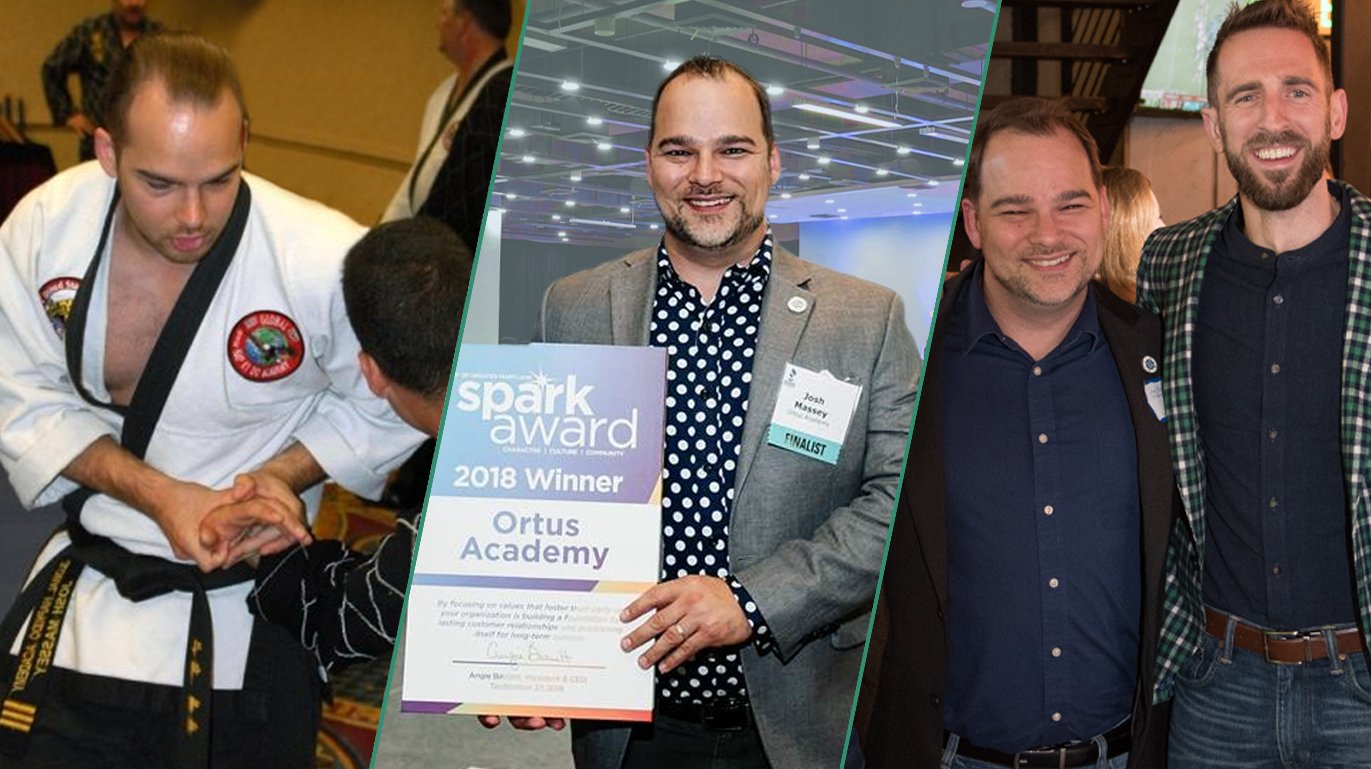
I am a 3rd-degree black belt in HapKiDo, a student of Jeet Kune Do and Filipino Stick Fighting, and a lifelong practitioner of Qi Gong. My martial arts journey didn’t just run parallel to my business career; it built the entire operating system that allows me to thrive as an operator, especially with an ADHD brain. It’s the same kind of foundational framework you’ll find in my COO Stability Compass.
The principles of the dojang are the principles of the boardroom. Here is what martial arts taught me about systems, focus, and leadership.
1. The Power of Consistent Practice: A Black Belt is a White Belt Who Never Gave Up
There is a saying in martial arts: “A black belt is a white belt who never gave up.”
In our culture of “hustle” and overnight success, we often forget this. We want the result, but not the process. As an operator with an ADHD brain, I crave novelty and stimulation. The “boring” work of checking the numbers, running the same weekly meeting, and refining a system 1% at a time can feel like a cage.
But my training taught me that mastery isn’t in the fancy, new techniques. Despite years of training, sometimes six days a week, most of what I continue to practice are the basics. They are just infinitely more refined. I now understand the nuances: the slight difference in an angle that increases power, the subtle pressure point, the shift in balance.
This is the very essence of a business operating system. It’s not about finding a new, shiny framework every quarter. It’s about the disciplined, consistent execution of your core processes: your weekly meetings, your financial check-ins, your 1-on-1s. The discipline comes from showing up on the days you don’t want to. Those are often the days you need it most.
Pro Tip: The belt system is a perfect analogy for business. You earn your “belt” in operations through consistent, focused effort, not by just showing up. You are always refining your basics while learning new skills. This mindset of “progress, not perfection” is critical.
Consider This Post: A Simple Framework for Creating Small Business Systems That Work. Mastering the “basics” in martial arts is like building foundational business systems. This guide provides a 5-step framework for designing the simple, repeatable processes you need to create stability and consistency in your operations.
2. Mastering the Flow: Yielding, Redirecting, and Being Like Water
My core style, HapKiDo, is similar to Aikido. The central tenet is to receive an attacker’s energy and redirect it. You do not meet force with force. You blend with their energy, use their off-balance position against them, and guide them where you want them to go (usually to the ground, with a joint bent in a direction it isn’t typically used to).
To do this, you must remain centered, anchored, and calm.
Does that sound like managing a founder’s “idea tornado”? It should. Fighting your founder’s energy is a losing battle. You will burn out, and they will get frustrated. The true art is to flow with their energy, accept it, and then redirect it into a structured container, like an Idea Dock, where it can be dealt with productively.
This philosophy of adaptability is a common thread:
- Bruce Lee famously said, “Be like water, my friend.” Water flows around obstacles, yet over time, it wears down the hardest rocks.
- A rigid tree will snap under the stress of a storm, but bamboo sways in the wind.
- In Jeet Kune Do, my instructor’s motto was, “Footwork, Footwork, Footwork.” Almost all problems could be traced back to the practitioner’s incorrect footwork. Weeks of agonizing practice on how we stepped seemed tedious, repetitive, and basic. But the proper footwork put us in a better position with the least amount of effort. It made us grounded and harder to knock down. It made us smoother, faster, and more confident in our abilities.
- One of my Hapkido instructors used to remind us, “Slow is smooth, and smooth is fast.” Practice slow, intentional movements. It is better to make mistakes at a pace that is easy to correct. Once you can operate slowly and smoothly, the speed will come naturally.
Your business systems are your footwork. They are your grounding. They are what allow you to remain balanced and adapt, to be the “empty shirt” on the clothesline that dances with the wind, rather than the rigid tree that snaps. Once your footing is steady, then you can move with ease and speed.
Consider This Post: The ADHD COO’s Guide to an Unstoppable Founder Partnership. The principle of “redirecting energy” is the most critical skill for managing your founder relationship. This guide provides the specific playbooks and communication frameworks you need to turn a founder’s chaotic energy into focused alignment.
3. The Discipline of Action: Punching vs. Hesitating
In martial arts and life, anticipation is tricky, but hesitation is deadly.
If you anticipate an opponent’s move and you are wrong, you might get punched in the face. But if you hesitate, you will undoubtedly get punched in the face. It is always better to throw a punch than to play defense.
This was never clearer than in stick fighting. The rattan sticks move fast, and they hurt. Your every instinct screams to back away, to avoid getting hit, but practicing without committing causes hesitation. You have to accept that you will get hit, you will fail.
As Mike Tyson said, “Everyone has a plan until they get punched in the face.”
In business, this is the fear of failure. We hesitate. We stay in The Fixer’s Trap, playing defense, because we’re afraid to launch the new project, delegate the important task, or have the hard conversation.
We must embrace action. Not every punch will land. Not every idea will be a success. As Ryan Holiday wrote in The Obstacle Is the Way, “Action and failure are two sides of the same coin.” This is why we build Minimal Viable Products (MVPs) and Minimal Viable Systems (MVS). They are the business equivalent of a controlled punch. It is better to invest a little, learn from the failure (the “kick to the stomach”), and adapt.
Anticipated failure is temporary and hurts far less than the regret of never starting.
4. Centering the Chaos: Qi Gong for the ADHD Mind
This is the most personal and critical lesson. My specific ADHD is internal. I can sit still, but my mind runs marathons. If I try traditional “quiet” meditation, my brain immediately rebels. The Sholin monks make it look easy and suggest, “Watch your thoughts fly away like balloons?” Okay. But what color is the balloon? How high will it fly with that much helium? Will it make a loud sound when it pops at that height – does sound change with gravity…?” My brain runs – and it’s exhausting.
The age-old advice of “Close your eyes, breathe, and count to 10” always elicits a question from those around me, “Are you ok?!” or “You look mad.” Nope, just trying to remain centered.
Qi Gong is one of my solutions. It is a style of moving meditation, similar to Tai Chi. Because it has a series of movements, often done in sets of three, my brain knows what is expected of it. I am moving, slowly, rhythmically. My mind focuses on the movement, on feeling grounded, on my breathing. A set of five movements can take 5-7 minutes and will completely reset my nervous system.
It centers me, creates calm, and allows my mind to quiet in a way sitting still never does. For any leader, but especially one with an ADHD brain, finding a personal practice to find your center is not a “nice to have.” It is an essential tool for survival.
Recommended Reading: The Way of the Peaceful Warrior by Dan Millman. It’s a parable about living in the moment. It’s fun, engaging, and is one of the books I recommend the most. There is a movie, too —but I would recommend reading it. Remember, “Never judge a book by its movie.”
Conclusion: Your Black Belt in Operations
You do not need to be a martial artist to be a great COO, but you must embrace the principles. Your role is to be the Black Belt Operator for your organization.
This journey teaches you that:
- Discipline is not about intensity, but about consistently showing up and mastering the basics.
- Adaptability is not about chaos, but about having a grounded “footwork” of systems that allows you to flow with new energy.
- Action is always preferable to hesitation. Progress requires a willingness to test, to learn, and to fail forward.
- Centering yourself is the prerequisite to centering your team. You cannot create calm if you are internally chaotic.
A black belt is not an endpoint. It is a symbol that you have mastered the fundamentals and are now ready for a lifetime of learning. A true Black Belt Operator is not someone who has all the answers, but someone who has built the discipline, adaptability, and resilience to find them.
Ready to Earn Your Black Belt in Operations?
This article outlines the principles of discipline, flow, and focus. But principles are nothing without a “dojo”—a structured place to practice—and a guide to show you the way.
The ADHD Operators Advantage Accelerator is that dojo.
This 12-week live group program is where we move from theory to real-world implementation. We won’t just talk about “footwork” and “focus”; we will build the actual, ADHD-friendly systems, communication rhythms, and leadership habits you need to:
- Stop sparring with chaos and start leading with calm.
- Master your “footwork” by building a grounded, reliable operating system.
- Find your center and lead with anchored confidence, even when you’re under attack.
If you’re ready to move from a white belt operator to a black belt leader, apply for the founding cohort.