
I have ideas for more books than I will ever write.
Not because I lack the material. Not because the ideas aren’t good. But because somewhere between the concept and the first chapter, my brain finds seventeen other things to research, refine, and optimize — and the actual writing never quite starts.
If you have ADHD, you already know this feeling. It isn’t laziness. It isn’t a lack of commitment. It’s the seductive pull of the planning phase, the place where every project is still perfect, still possible, still untested by the messy reality of actually doing the thing.
In the world of continuous improvement, there’s a framework: the PDCA Cycle (Plan, Do, Check/Correct, Act). It’s one of the most widely used operational models in lean organizations, and for good reason. It works. But for a COO or Operations Manager with ADHD, the cycle has two failure modes that no one talks about — and both of them will stall your operation in completely different ways.
The first is spending too long in the PLAN phase and never starting. I call this The Pink Trap.
The second is skipping the PLAN phase entirely and spending the rest of your time in permanent CORRECT mode, always fixing, never building.
Let’s talk about both. Because your team, your CEO, and your own ADHD brain are probably pulling you toward one of them right now.
What the PDCA Cycle Actually Is
Before we go further, a quick grounding for anyone new to the framework. The PDCA Cycle, also known as the Deming Cycle, is a four-stage model for continuous improvement:
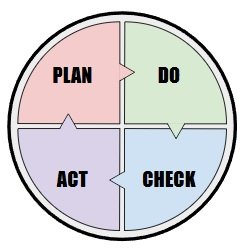
Plan: Identify the problem or opportunity, analyze root causes, and design a solution.
Do: Implement the solution, ideally on a small scale first, to test your core assumptions.
Check/Correct: Evaluate the results honestly. What worked? What didn’t? What needs adjusting?
Act: Standardize what worked. Build it into your systems and processes. Then begin the cycle again.
The model’s genius lies in that last step. It never actually ends. Each cycle feeds the next, building smarter, more resilient systems over time. For a deeper look at the framework’s history and mechanics, this overview from Spica is worth bookmarking.
Did you notice how all four parts are equal?
Now here’s what the textbook version won’t tell you.
The Two Failure Modes (And Why ADHD Makes Both Worse)
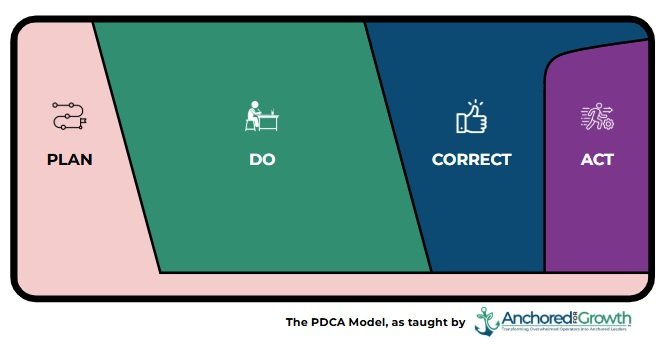
Look at the diagram above. Notice how the proportions of each phase, except the DOING phase, change depending on how much time you spend in PLAN.
When you plan well, the DO phase dominates, CORRECT is present but manageable, and ACT is reachable. The cycle moves forward.
When you skip planning almost entirely, something else happens: the CORRECT phase expands to fill everything planning didn’t cover. It grows massive. It crowds out the ACT phase. And without ACT, the standardization phase, the one that turns a one-time success into a repeatable system, you never actually finish the cycle. You just keep correcting the same problems in slightly different forms, indefinitely.
This is the operational reality for teams that sprint before they orient. The firefighting never stops because the root causes were never identified. Every week brings new versions of the same three problems, and the leader in the middle of it all wonders why nothing ever seems to stick.
For the ADHD operator, the cruelty is that both failure modes feel natural at different moments. When your brain is chasing the dopamine of planning, you’ll stay pink forever. When your CEO is pushing for speed, and you haven’t fully established your role, you’ll skip planning entirely and end up living in CORRECT.
The Anchored Leader’s job is to hold the middle.
Real Talk: Permanent CORRECT mode isn’t agility. It’s an operational tax your team pays every single day, in wasted effort, eroded trust, and the quiet exhaustion of fixing things that didn’t have to break.
Consider This Post: If your operation already feels like a tangle of recurring problems with no clean resolution, Untangling the Spaghetti: A Guide to Business Process Simplification introduces the ANCHOR Framework, a practical method for finding the elegant system on the other side of the complexity.
Failure Mode One: The Pink Trap (Too Much Planning)
The PLAN phase is addictive for ADHD brains, and not by accident. Planning is solving puzzles. You’re researching the perfect project management tool, learning a new automation skill, and mapping out every possible scenario before committing to one. It feels productive. It looks productive. Your calendar is full, your tabs are open, your notes are color-coded.
But it’s a delay tactic dressed in a productivity costume.
There’s a concept in the ADHD world that cuts straight to the heart of this: “Want a clean house? Throw a party.” External accountability, a real deadline, a consequence that matters — these are what finally move an ADHD brain from planning to doing. I’ve deliberately used this in my own work, including enlisting a close friend as an accountability partner for a business book I’m currently writing. Left entirely to my own devices, I’d still be researching the outline.
The PLAN phase is seductive for a specific reason: the project is still perfect. It hasn’t yet met the friction of reality. The moment you move to DO, you might be wrong. You might have to correct. And for an ADHD brain wired with Rejection Sensitive Dysphoria, being wrong doesn’t just sting — it can feel like a verdict on your entire competence as a leader. So we plan a little more instead.
The antidote isn’t recklessness. It’s the Minimum Viable Plan: enough framework to identify the major pitfalls before they become emergencies, a defined endpoint for the planning phase itself, and the discipline to move when you hit it.
Pro Tip: Set a hard deadline for your planning phase before you start it. Not “when it feels ready,” because for an ADHD brain, that moment may never come. Decide in advance: “I have until Thursday at noon to plan this. Then we move.” The deadline is the party invitation.
Consider This Post: If perfectionism and task paralysis are keeping you anchored in the pink, The Fixer’s Trap: Are You the Business Bottleneck? takes a hard look at how the need to get it right can quietly become the thing that keeps the ship in port.
Failure Mode Two: The Permanent Correction Loop (Too Little Planning)
Now, for the failure mode, your CEO is more likely to create.
In a startup environment, speed is often treated as the highest virtue. Your Visionary sees a YouTube video, reads a book, attends a workshop, and by Monday morning, there’s a new product line, a new company direction, and a request for immediate execution. COOs who haven’t fully established their role often spring into action without pausing to push back. The energy is high. The momentum feels real.
A week later, something breaks that a few hours of planning would have caught. That week of effort is gone. The team is demoralized. And now you’re in CORRECT mode, spending more time fixing the preventable problem than the planning would have cost in the first place.
I watched this play out directly in my martial arts business. We’d have an idea for a new online course or workshop, and it genuinely sounded great. It made sense internally. So we built it: hours of development, real revenue invested. And then it launched to almost no interest, because we’d skipped the step where we asked whether people actually wanted what we were building. The product was finished. The market wasn’t there. A few hours of validation planning and a simple conversation with our existing community would have saved both the time and the money.
This is what the diagram is actually showing. The CORRECT phase doesn’t just get a little bigger without planning. It gets massive. It becomes indefinite. And the ACT phase, the one where you standardize and scale what works, gets squeezed into almost nothing, because you never have enough clean runway to build on. You’re always in recovery.
Winston Churchill said it better than anyone: “Planning is everything, the plan is nothing.” The value isn’t the document. It’s the preparation that keeps you out of the permanent correction loop.
Pro Tip: When your CEO pushes for immediate action, the Anchored Leader’s response isn’t resistance. It’s redirection: “I’m with you on moving fast. Give me 24 hours to map the major risks so we don’t lose a week correcting something preventable.” That’s not slowing the ship. That’s making sure it can actually sail.
Consider This Post: If you’re regularly absorbing the blast radius of a speed-first CEO, Stop Shiny Object Syndrome with the Idea Dock gives you a practical tool for honoring the energy without derailing the operation. And if the tension between your pace and your CEO’s runs deeper than individual decisions, The ADHD COO’s Guide to an Unstoppable Founder Partnership is the place to start rebuilding the foundation.
The Do Phase: Where the Real Data Lives
Here’s the truth that most planning-addicted operators need to hear: the doing is the same, regardless of how long you planned.
More planning doesn’t change the nature of the work. It changes how much you have to correct afterward. With a solid Minimum Viable Plan, you’ll hit fewer unexpected walls. Without one, the CORRECT phase expands to fill the gap. But the actual execution, the work itself, cannot be fully optimized in advance. The only way to discover where you misevaluate is to start.
This is where I recommend the Minimum Viable System: don’t build the full process on day one. Build the simplest version that tests your core assumption. Get it running. Let reality give you the data that no amount of planning can manufacture.
When I’m stuck between planning and starting, I go for a walk. Not to think harder, but to create enough space to ask one question: “What is the easiest, or most enjoyable, piece of this I could start with right now?” Not the whole thing. Just the doorway in. The ADHD brain doesn’t need a perfect runway. It needs a spark.
Pro Tip: If task initiation is the wall between your PLAN and DO phases, shrink the entry point until it feels almost embarrassingly small. Ten minutes. One decision. One section. Forward motion generates its own momentum in a way that planning never can.
Consider This Post: For larger initiatives where the gap between planning and execution involves an entire team, The Anchor’s Job: Translating Your CEO’s 10-Year Vision into a 90-Day Execution Plan gives you the sprint framework that makes the DO phase tangible and time-bound.
The Check/Correct Phase: Data, Not Verdict
For ADHD leaders, the CORRECT phase carries a hidden tax beyond the operational one.
When the DO phase surfaces mistakes, and it always will, the evaluation of those mistakes can trigger RSD. The CORRECT phase stops feeling like a data-gathering exercise and starts feeling like a verdict on your judgment, your competence, your worth as a leader. The result is that many of us rush through it, minimize it, or avoid it entirely — which means the same problems resurface in the next cycle, and the one after that.
The reframe that changes this is simple but has to be deliberate: correction is not failure. It is the system working.
The entire point of the PDCA cycle is that you will not get everything right on the first pass. That’s not a flaw in your execution. It’s a feature of the model. Every finding in the CORRECT phase is intelligence that makes the next cycle faster, cheaper, and more precise. The leader who checks thoroughly and corrects honestly builds better systems than the one who plans endlessly and never has to confront what reality taught them.
And here’s the compounding argument from the diagram: the less thoroughly you correct, the larger the CORRECT phase becomes in the next cycle. Skipping or rushing the CHECK isn’t saving time. It’s borrowing against the next loop at a high interest rate.
Real Talk: The gaps you find in the CORRECT phase aren’t a reflection of how well you planned. They’re proof that you were brave enough to start.
Consider This Download: If your CORRECT phase consistently surfaces more problems than you can prioritize, the COO Stability Compass is a free 10-minute assessment that helps you identify where to focus first, so the correction phase becomes a productive sprint rather than another source of overwhelm.
The Act Phase: The Exit Ramp Most ADHD Leaders Miss
You’ve planned. You’ve done. You’ve corrected honestly. And now comes the phase that quietly ends more ADHD-led initiatives than any other: ACT.
The ACT phase is where you standardize what worked and put it into ACTion. You document the process, build it into the operating system, and make the improvement repeatable. It is the most important phase for long-term operational health. Without it, every successful DO phase is a one-time event rather than a permanent upgrade to how the business runs.
Look at the diagram again. When planning is minimal and the CORRECT phase expands indefinitely, the ACT phase shrinks to almost nothing. There’s simply no clean runway to standardize on, because you’re still correcting. This is how teams end up running the same initiative three times without ever building the system that makes a fourth time unnecessary.
The ACT phase also happens to be the least dopamine-generating thing you’ll do all week. The novelty is gone. The puzzle is solved. The doing is done. All that’s left is the unglamorous work of turning a one-time success into a permanent standard — and your ADHD brain is already scanning for the next interesting problem.
This is where Michalowicz’s 4Ds, found in Clockwork, become genuinely useful, and where the fourth D is the one most operators underuse:
- Design — You built the plan.
- Do — You (or the team) executed the plan.
- Decide — You evaluated the results and chose the path forward.
- Delegate — You hand the standardization to someone else.
That last step is harder than it sounds. You’ve invested in this project. You’ve built a connection to it. Letting someone else own the ACT phase can feel like giving away something that belongs to you. But what I’ve found consistently is that when you hand the ACT phase to the right person, someone with more proximity to the day-to-day execution, they surface things you missed. A step that only makes sense to you. A dependency that wasn’t documented. A flaw in the logic that your closeness to the project made invisible. The handoff is quality control by a different name.
That said, delegation isn’t a universal solution. Not every team has the right person available, and not every project is appropriate for handoff. If delegation isn’t an option, timebox the ACT phase with a hard end date before the next project begins. Without a boundary, the standardization never happens, and the cycle quietly dies before it completes.
Consider This Post: If releasing the “how” and trusting someone else to carry it forward is consistently where your initiatives stall, the “Who Not How” Framework for ADHD Delegation walks through exactly how to make that handoff without losing quality or control.
Holding the Middle: The Anchored Leader’s Job
The Anchored Leader’s job in the PDCA cycle isn’t to be the fastest or the most thorough. It’s to hold the tension between two failure modes that are always pulling in opposite directions.
Your ADHD brain wants to stay in PLAN, where it’s safe and the dopamine flows. Your CEO wants to skip PLAN entirely, treating speed as progress. Neither extreme serves the operation.
The middle ground is a Minimum Viable Plan: enough preparation that the CORRECT phase stays manageable, enough momentum that the DO phase actually starts, and enough discipline to reach ACT before the next shiny idea pulls you back to a fresh PLAN phase on something new.
This is also where knowing your team’s rhythms matters. Just as we discussed in Energy Management for ADHD Leaders, the people you’re leading have their own cycles, their own capacity at any given moment, and their own relationship with uncertainty. Assigning complex DO-phase work to someone already drowning in CORRECT-phase cleanup is a fast way to compound a problem that planning would have prevented.
Consider This Post: The COO leadership mindset required to hold this tension over the long term, steady in the Monsoon without getting swept away by it, is explored in depth in The Paradox of the Anchored Operator.
Conclusion: Stop Perfecting. Start Cycling.
If you are stuck in the pink area right now — researching the right tool, refining the plan, waiting for the certainty that will never quite arrive — I want you to hear this clearly: YOU ARE NOT BROKEN!
You are an operator who cares deeply about quality. That instinct is one of your greatest strengths. But the diagram tells the story plainly. Too much PLANNING and you never start. Too little PLANNING and you never finish — you just correct, and correct, and correct, and the ACT phase that would have made all of it stick never arrives.
Churchill was right, “Planning is everything. The plan is nothing.” Get the map. Take the first step. Correct with honesty and without shame. And when the system works: standardize it, hand it off, and let it run without you.
The goal was never a perfect plan. It was a better operation on the other side of the doing.
Frequently Asked Questions: PDCA for ADHD Leaders (ADD THESE!)
Ready to Break the Cycle (In the Best Way)?
If you recognized yourself somewhere in this article — stuck in the pink, stalled in the act, or living in permanent CORRECT mode — you don’t have to untangle it alone.
In a complimentary 30-Minute Clarity Call, we’ll identify exactly where your PDCA loops are breaking down, which phase is costing you the most right now, and what one change would unlock the most momentum in your operation.