It’s Monday morning. You haven’t even finished your coffee. Your CEO walks in, eyes lit up like they just discovered fire, and drops a new vision so big it could swallow the next six months whole.
“This changes everything,” they say. “We need to move on this, now.”
Your stomach drops. You know exactly what “now” means. It means chaos for your team, half-finished projects abandoned mid-sprint, and three months from now, facing another “game-changing” idea that makes this one obsolete.
If you are in the “Middle Seat” of an early-stage company, whether your title is COO, Ops Manager, Integrator, or Chief of Staff, you know this feeling viscerally. It’s a mix of excitement because the idea is genuinely brilliant, and sheer terror because you know your team is already at capacity.
Early in my career, my instinct was to say “Yes, let’s do it!” I was inspired and caught up in the excitement. I thought my job was simply to execute whatever the Visionary dreamed up. I wanted to be the hero who made things happen. I lived for those moments.
But I learned the hard way that when the wheel is turned too quickly, or the wind shifts suddenly, the boat doesn’t necessarily turn faster: the sails tear (team dynamics dwindle) and the mast snaps (personal burnout).
When you try to execute a 10-year vision in a timeframe measured in days, you break your team. You spend the next six months repairing the damage rather than moving forward.
Your job isn’t to kill the momentum. You need that visionary energy to propel the business; it is the wind in the sails. Your job is to steer the ship so it doesn’t capsize. You have to translate “Someday” into “Monday morning.”
Here is how Anchored leaders bridge the gap between massive vision and quarterly traction.
The “Fixer” Instinct and the Cost of Operational Chaos
The hardest word for an early-stage Operator to say to their Founder is “Not yet.”
We are wired to be doers and fixers. When the CEO brings us a new challenge, we get a dopamine hit from solving the puzzle. It feels productive to jump into action immediately.
For leaders with ADHD traits, which research suggests may be highly prevalent among entrepreneurs, this pull toward novelty and immediate action is even stronger. The neuroscience is clear: new ideas trigger dopamine release, creating a neurochemical reward that can override strategic thinking.
But constant pivoting in response to shiny objects creates what researchers call “strategic whiplash.” Organizations experiencing frequent strategic shifts face significant challenges. According to Gallup’s State of the Global Workplace reports, employee stress is at record highs, and inconsistent direction is a major contributor to burnout and disengagement.
You end up with a dozen “half-finished bridges.” There are tons of activities, and everyone is busy, but you never actually cross the chasm to the other side. Eventually, your team stops trusting the direction because they know it will change again next week. This doesn’t breed trust and can erode company culture quickly.
I once worked with a CEO/owner who, in a single quarter, tried to launch three new product ideas, redesigned the website twice, and decided we needed to pivot our entire go-to-market strategy. All of this came because of insights from different podcasts he’d binged over a few weekends and feedback from one investor (who never ended up investing in us).
By month two, the team was paralyzed. No one knew what to prioritize. People stopped asking “What’s the plan?” and started asking “What’s the plan this week?” We weren’t building; we were pivoting in circles.
To become an Anchor, you must shift your mindset from being an “Order Taker” to a “Strategic Filter.”
Your True Role: The Strategic Translator (Visionary vs. Integrator)
In the framework popularized by EOS (Entrepreneurial Operating System) and the seminal book Rocket Fuel, the Visionary/Integrator relationship is key to scaling.
The Visionary owns the “What” and the ultimate “Why”, the destination.
But the Integrator, the Anchor, must own the “How” and, crucially, the “When.”
Pro Tip: Rocket Fuel is the first book I recommend for startup executives to read. It helped me and my partner enormously when we were struggling, lost at sea, and seeking clarity on our roles. It gives you a shared language and great conversation starters for defining your partnership.
Why do you own the “When”? Because you are the one sitting in the middle seat. You have the clearest view of the company’s finite resources: time, money, and human bandwidth.
This isn’t just management theory; it is backed by organizational science. Resource Dependence Theory suggests that those who control critical resources, in this case, the operational capacity to execute, must hold significant sway over organizational strategy. You cannot build a skyscraper if you only have the bricks for a shed, no matter how beautiful the blueprint is.
When you push back on timing, you aren’t being insubordinate or killing dreams. You are practicing good stewardship and necessary boundary setting for the company’s capacity.
Consider This Post: Are you struggling to define where the CEO’s job ends, and yours begins? Stop stepping on each other’s toes. Read The Visionary and Integrator: 3 Conversations to Define Your Partnership.
The Reality Filter: A Framework for Grounding Visionary Ideas
When that giant, fluffy, 10-year idea lands on your desk, don’t just accept it and start assigning tasks. Run it through a filter first.
You need a toolkit of diagnostic questions to slice the project down to size. It is best to validate your visionary’s idea first. Be careful not to patronize them, but give yourself some time to digest the new plan before coming back with action-based questions.
Step 1: The Internal Gut-Check (Ask Yourself First)
It is best to weather the “Idea Tornado” before you start trying to navigate. Before you even bring this new idea to the team, pause and ask yourself:
- Is this a critical strategic pivot based on real data, or is this just the newest trend that has them excited right now?
- Does this align with market signals and current customer feedback, or is it based on a feeling from a single conference keynote?
- Have I seen this pattern before? What happened the last three times they got this excited?
You know your CEO’s patterns better than anyone. You have learned to distinguish between their “conference high” ideas and their genuine strategic insights. Trust your instincts. In neurodiversity-aware language, you are helping regulate what some call “idea flooding,” when executive function challenges around prioritization make every new concept feel equally urgent.
Step 2: The Direct Questions (Ask Your CEO)
If the idea passes your gut check, now you must force a confrontation with reality. Use these three questions in your next one-on-one:
1. The Trade-Off Question: “I love this idea. If we execute this right now, what current priority gets thrown overboard? Because something has to.”
Never let them say “nothing.” That is a lie. The “Zero-Sum Reality” of early-stage operations means every “yes” to something new is an automatic “no” to existing work. Make the trade-off explicit.
2. The Bandwidth Question: “Who specifically on the team has the capacity to own this today without dropping their current rocks?”
Force them to name names. Not “the team will handle it.” Not “we’ll figure it out.” Who? When you make it concrete, the capacity constraints become undeniable.
3. The Alignment Question: “How does starting this today help us achieve the 1-year goal we agreed on last quarter?”
Anchor the conversation back to the commitments you have already made. If it doesn’t connect, it needs to wait.
Pro Tip: Be blunt but kind. Some Visionaries love being challenged; others feel invalidated. Know your partner. If you need to soften the blow, frame it as protection: “I want to make sure we execute your vision flawlessly, which means we need to clear the decks first.” Understanding Rejection Sensitive Dysphoria (RSD), common in ADHD brains, helps here. It’s not about dimming their enthusiasm; it’s about channeling it strategically.
Why the 90-Day Execution Plan is Essential for Startups
I am okay with a 3-year plan. Investors need to see a long-term vision to understand the scale of the opportunity, and the team needs a compass heading for inspiration.
But we have to recognize that anything beyond three years is purely speculative. The market, technology, and global circumstances change too fast. Think about how many 5-year plans written in 2019 were rendered useless by 2020. Having a plan allowed businesses to pivot, but the plan itself had to change radically.
For actual execution, the 90-day horizon is magic.
Organizational psychology, specifically Goal-Setting Theory, pioneered by researchers Locke and Latham, demonstrates that specific, challenging goals with tighter timeframes lead to higher performance than distant, vague aspirations. The key is that these goals must be attainable within a reasonable timeframe while still stretching the team’s capabilities.
Why does 90 days work? Because it is long enough to get real, meaningful work done, but short enough to maintain focus before the market, or the CEO’s mind, shifts again. In practice, companies that operate in quarterly cycles consistently report better focus, clearer priorities, and less strategic drift than those working solely toward annual goals.
If a new idea doesn’t fit in the current 90-day sprint, it doesn’t have to die. It goes to the Idea Dock to cool off until the next quarterly planning session.
Especially in the first 5 years of a startup’s life, you will experience pivots you cannot see coming. New tech, hires, firings, and funding will all shift your course. You need a system agile enough to adapt. If not, you will sink.
Consider This Post: Is your team suffering from whiplash because priorities change every week? Stop the chaos. Learn how to implement a system for parking new ideas in Stop Shiny Object Syndrome with The Idea Dock.
Navigating the “Dopamine Trudge”: Managing Mid-Quarter Slumps
If you are working with a Visionary leader with ADHD traits, the 90-day cycle has a predictable rhythm.
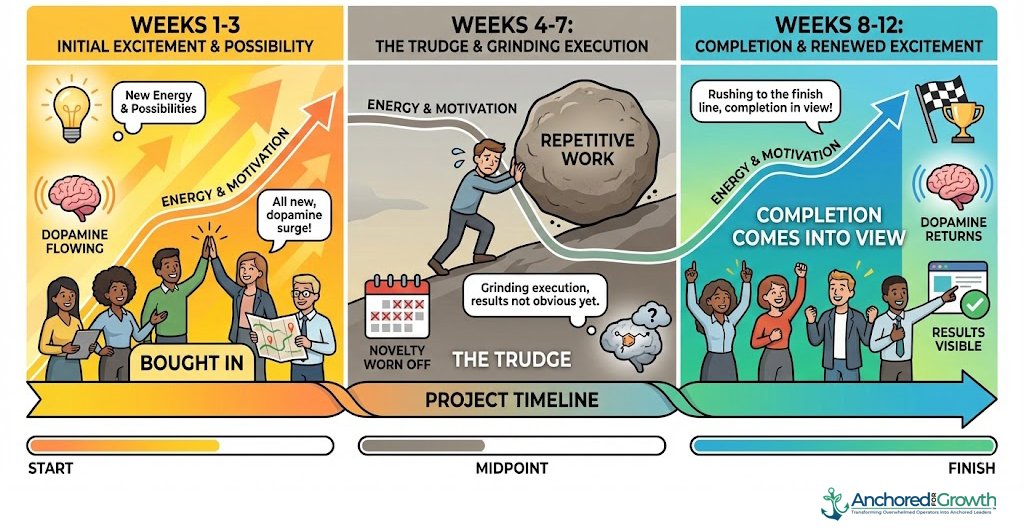
Weeks 1-3 are exciting. It’s all new energy and possibilities. The dopamine is flowing. Everyone is bought in.
Weeks 8-12 are exciting again. You are rushing to the finish line and seeing results. The dopamine returns as completion comes into view.
But Weeks 4-7? That is the “trudge.” The novelty has worn off. The work is repetitive, grinding execution. Results aren’t obvious yet.
This is the danger zone. An ADHD Visionary brain, starved for dopamine, is most likely to throw a grenade into the process during these weeks just to feel stimulation. Research indicates that high novelty-seeking behavior is a core component of ADHD, making extended periods of routine tasks incredibly difficult.
Furthermore, an ADHD Integrator brain can also get starved for that dopamine rush. This is when the work is the most boring, taxing, and requires the most consistency.
As the Anchor, you need tactics to bridge this gap:
Show Ugly Demos: Don’t wait for perfection. Show tangible progress every week, even if it is wireframes, rough drafts, or messy spreadsheets. Reignite excitement about what is currently being built so they don’t look for excitement elsewhere. This leverages what Harvard researcher Teresa Amabile calls “The Progress Principle”: the psychological boost we get from seeing forward movement, no matter how small.
Celebrate Micro-Wins: Focus heavily on the positive momentum of the current plan. “We hit 60% of our user acquisition target in Week 5” is more motivating than “We are still 40% short.” Frame the narrative around what is working.
Reframe the Trudge as Progress: When your CEO starts getting antsy in Week 5, remind them that this, the tedious, repetitive grind, is what separates companies that scale from companies that stall. The trudge isn’t a bug; it is a feature. It is proof that you are doing the hard work of execution, not just ideation. As Jim Collins famously wrote, “Good to Great” happens in the unsexy middle, not just the flashy launch.
The “Break Glass” Option: If they are truly too volatile to handle the boredom of execution during the trudge, encourage them to go to another conference, an advisory meeting, work on the pitch deck… Sometimes, the best thing for the team is for the Visionary to channel their energy elsewhere for a few days. Let them fill their dopamine tank externally while the team maintains momentum internally.
Consider This Post: Are you stuck in the weeds, unable to focus on strategic execution because you are doing everything yourself? You need a new framework for delegation. Read The “Who Not How” Framework for ADHD Delegation: How Operators Escape the Weeds.
Your Next Step
If you are drowning in your CEO’s “game-changing” ideas right now, here is what to do this week:
- Book 30 minutes with your CEO. Label it “Quarterly Priorities Check-In.” Make it sound strategic, not confrontational.
- Bring the three questions above. Don’t ambush them, but gently force the trade-off conversation. Write them down beforehand. Rehearse if you need to.
- Propose a 90-day sprint. Show them how focusing on one or two big things for 90 days will get them further than chasing ten things. Use data if you have it. Use stories if you don’t.
- Acknowledge their vision. Start with validation: “This idea is genuinely exciting, and I want to make sure we execute it brilliantly.” Then anchor them: “Which means we need to time it right.”
You aren’t killing their vision. You are translating it into reality. You aren’t slowing them down. You are making sure that when they finally set sail, the wind actually moves the ship forward instead of tearing it apart.
Conclusion
Being an Anchor isn’t about being a naysayer or a dream-killer. It is about ensuring the visionary energy actually propels the business forward rather than destroying the operational foundation.
It takes courage to slow down the translation process. It feels counterintuitive to say “wait” when your CEO is yelling “GO!” But it is the only way to build sustainable growth without burning out the people doing the work.
Drop your anchor. Take a breath. Recalibrate the course. Then raise the anchor and sail with intention, not just motion. That is how you translate a 10-year vision into 90-day traction without snapping the mast.
Drowning in your CEO’s constant stream of “game-changing” ideas?
You’re not alone. The struggle to translate visionary energy into focused execution without breaking your team is one of the most common challenges I see with the COOs and operators I coach.
If you’re tired of strategic whiplash, endless pivots, and watching your team’s trust erode with every new direction, it’s time to build a different system.
I work with operational leaders like you to:
- Establish clear boundaries and decision-making authority with your CEO
- Design 90-day execution rhythms that actually stick
- Filter ideas strategically without killing momentum
- Build systems that support ADHD brains (yours or your CEO’s)
- Reclaim your time and sanity without sacrificing growth
Ready to drop your anchor and lead with clarity?
Schedule a free 30-minute Clarity Call and let’s talk about how to translate your CEO’s 10-year vision into sustainable 90-day traction.